Is That Heirloom a Hidden Gem? A Practical Guide to Identifying Rare Stones with AI
The Mystery in the Jewelry Box
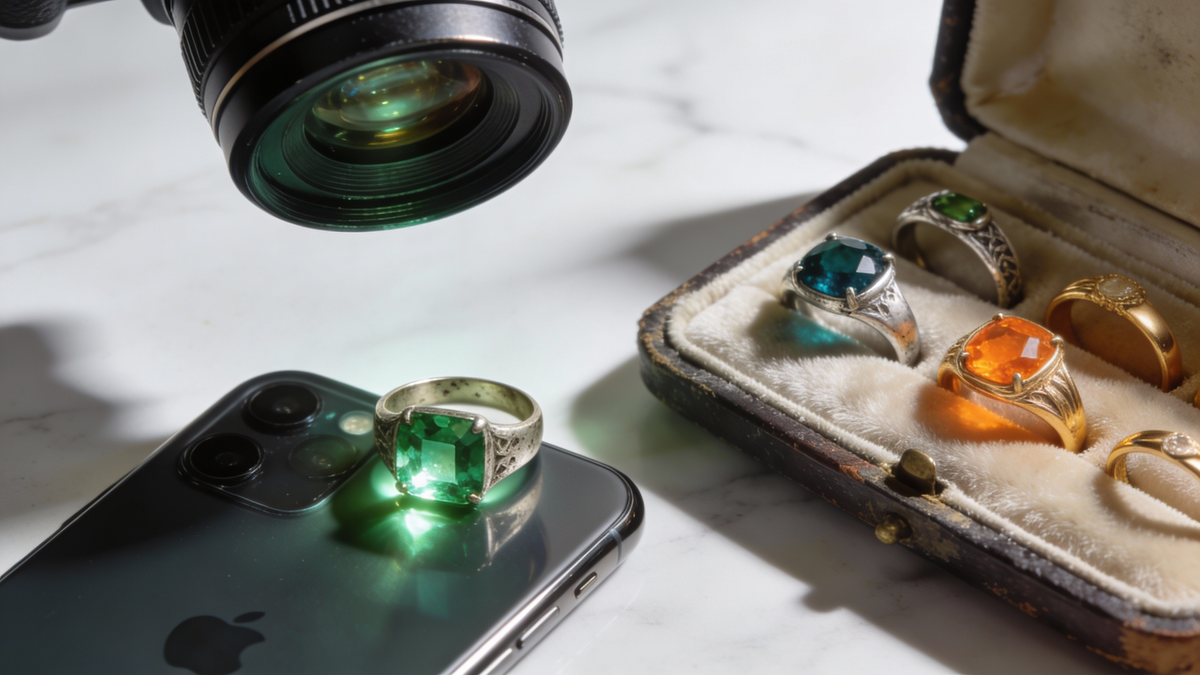
We’ve all been there. You’re looking through an old jewelry box—maybe it’s a collection of thrift store finds, or perhaps a velvet-lined case inherited from a grandmother—and you spot it. A deep, forest-green stone set in a tarnished silver ring, or a fiery orange pendant that looks just a little too vibrant to be glass.
Your mind immediately goes to the big question: What is this, and is it worth anything?
In the past, getting an answer meant making an appointment with a professional gemologist, paying a hefty appraisal fee, and waiting days for a verdict. For a single piece of jewelry that might just be costume glass, that’s a lot of friction.
Today, technology has caught up to our curiosity. While it doesn’t replace a certified GIA appraisal for insurance purposes, AI-powered identification has become a legitimate starting point for hobbyists and collectors alike. Let’s dive into how you can use these modern tools to separate the treasures from the trinkets.
Why Identifying Gemstones is Harder Than It Looks
Before we jump into the tech, we have to acknowledge the reality: gemstones are tricky. Nature is a master of disguise, and humans have become very good at creating "simulants" (stones that look like the real thing but aren't).
For example, a red stone could be a Ruby, but it could also be a Garnet, a Red Spinel, or even a high-quality piece of red glass known as "paste." To the naked eye, they can look identical.
Professional gemologists look at several factors: 1. Refractive Index: How light bends as it passes through the stone. 2. Inclusions: Tiny internal flaws or "birthmarks" that tell the story of how the stone formed. 3. Hardness: Where it sits on the Mohs scale. 4. Specific Gravity: The density of the material.
AI works differently. It uses Computer Vision and Pattern Recognition. By analyzing thousands of data points in a photo—color saturation, crystal structure, light refraction patterns, and setting styles—AI can provide a high-probability identification in seconds.
How to Use AI for Gemstone Identification (The Right Way)
If you want an accurate result from an AI tool, your input needs to be high-quality. Garbage in, garbage out. Here is the workflow I recommend for the best results.
1. Lighting is Everything
Never use your camera flash. It creates "hot spots" on the facet of the stone that blind the AI. Instead, use natural, indirect sunlight. A window sill on a bright day is perfect. If you’re indoors, use a neutral white LED light. Avoid yellow incandescent bulbs, as they will make a blue sapphire look teal or a clear diamond look yellowish.
2. Clean the Stone
A fingerprint can make a high-quality diamond look like a dull piece of cubic zirconia. Use a lint-free microfiber cloth (like the ones for eyeglasses) to wipe away oils and dust before taking your photo.
3. Focus and Macro Mode
Most modern smartphones have a "Macro" mode that kicks in when you get close to an object. Ensure the internal facets of the stone are in sharp focus, not just the metal prongs of the setting. If the AI can see the way light bounces inside the stone, its accuracy increases significantly.
4. Use a Dedicated App
While a general Google search can help, specialized tools are trained on specific mineralogical databases. Tools like Jewelrify are specifically designed for this. By using the AI-powered jewelry identifier within the app, you’re tapping into a system trained to recognize the subtle differences between a natural emerald and a lab-grown synthetic based on visual markers.
Beyond the Photo: Physical Clues to Look For
AI is a powerful ally, but you should combine its findings with some "old school" observation. Here are three quick tests you can do at home:
The Fog Test (For Diamonds)
Put the stone near your mouth and huff on it like you’re trying to fog up a window. If it stays fogged for a few seconds, it’s likely a simulant. Real diamonds disperse heat almost instantly and will clear up in less than a second.
Look at the Wear and Tear
Check the "facets" (the flat surfaces) under a magnifying glass or your phone’s zoom. Are the edges where the facets meet sharp and crisp? That’s a sign of a hard stone like a Diamond or Sapphire. Are the edges rounded, chipped, or scratched? It’s likely glass or a softer semi-precious stone like Fluorite.
The Setting Tells a Story
Look at the inside of the band or the back of the pendant. Look for stamps like "925" (Sterling Silver), "14K" or "585" (14-karat gold). Generally, high-value rare gemstones aren't set in cheap base metals. If you find a "750" (18K gold) stamp, it’s worth taking a much closer look at the stone.
The Role of AI in Estimating Value
Once you’ve identified that your stone is, for example, a Tanzanite, the next question is value. Gemstone value is highly subjective, based on the "Four Cs" (Color, Cut, Clarity, and Carat weight).
AI can help here by comparing your stone’s visual characteristics against current market data. Some apps, including Jewelrify, offer a gem value estimation feature. This won't give you a legal document for a Christie’s auction, but it will tell you if that ring is worth $50 or $5,000. This is incredibly helpful when you’re deciding whether it’s worth the $150 fee for a professional lab report.
When to See a Professional
AI is a fantastic screening tool, but it has limitations. It cannot definitively distinguish between a natural, earth-mined stone and a high-quality lab-grown stone of the same chemical composition (like a lab-grown vs. natural ruby) because they look identical to the eye.
You should seek a professional appraisal if: - The AI identifies the stone as a high-value gem (Diamond, Ruby, Emerald, Sapphire, Alexandrite). - You plan to sell the item on a platform like Sotheby's or 1stDibs. - You need to add the item to your homeowner’s insurance policy. - The piece is a complex antique with historical significance.
Putting it Into Practice
If you’re staring at a piece of jewelry right now, try this: Clean it, take it to a window, and use an identifier app to get a baseline. See what the AI suggests, then look at the metal markings to see if they align. It’s a fascinating way to learn more about mineralogy and the history of your own collection.
Identifying gemstones used to be a closed world accessible only to experts with loupes and chemical kits. Today, that world is open to anyone with a smartphone and a bit of curiosity. Happy hunting!
Ready to identify your collection?
If you want to start scanning your jewelry and gemstones today, you can download Jewelry Identifier: Gem Value (Jewelrify) on your mobile device:
Download on the App Store or Google Play.