
Squinting at the Line: The Science of Evaporation Lines vs. Early Positives
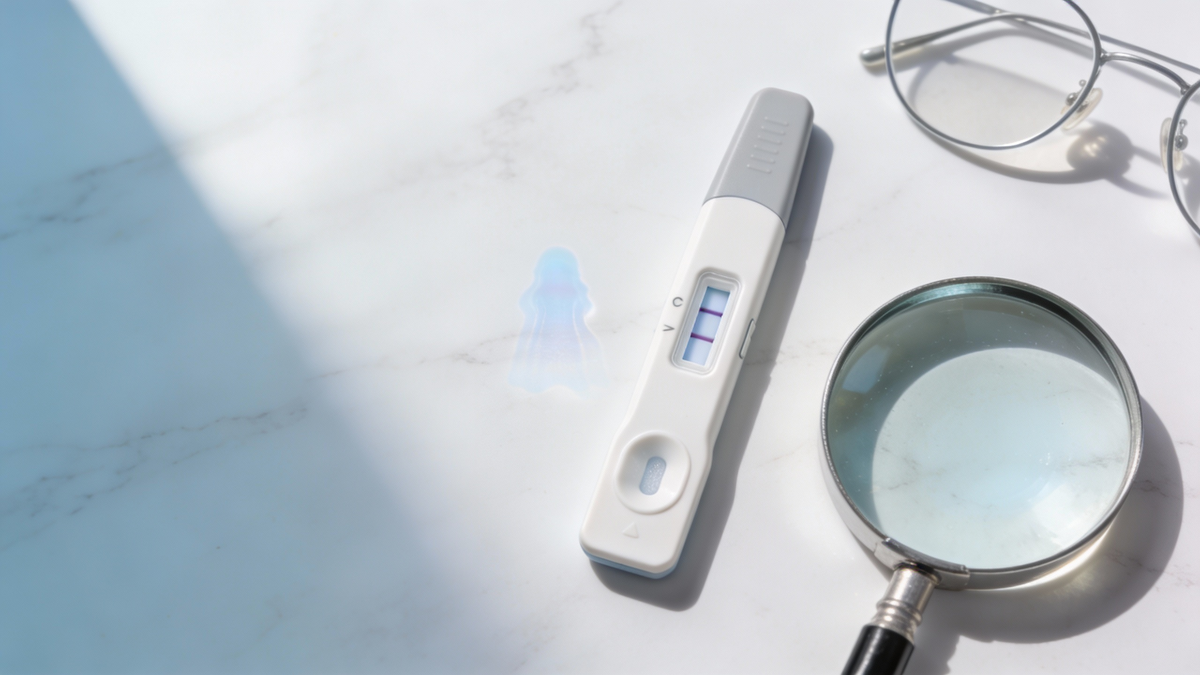
The 'Squinter' Dilemma
You’re in your bathroom, holding a plastic stick under the brightest light in the house. You see something. It’s not a bold, undeniable stripe, but it’s not a blank white space either. It’s a shadow, a ghost, a 'maybe.'
If you’ve ever found yourself tilting a pregnancy test at a 45-degree angle or taking a photo and messing with the contrast settings to see if a line appears, you are not alone. This is the frustrating reality of early testing. The problem is that not all lines are created equal. Some mean you’re pregnant; others are simply the result of chemistry and physics as the urine dries. These are known as evaporation lines (or 'evo lines'), and they are the source of more heartbreak and confusion than almost anything else in the world of TTC (trying to conceive).
In this guide, we’re going to break down the science of why these lines happen, how to spot them, and how to get the most accurate result possible today.
What Exactly Is an Evaporation Line?
To understand an evaporation line, you first have to understand how a pregnancy test works. Most home tests use Lateral Flow Immunoassay technology. When you apply urine, it travels across a nitrocellulose membrane. This membrane contains reactive antibodies that 'catch' the hCG hormone (human Chorionic Gonadotropin).
If hCG is present, it binds to these antibodies, which are also attached to a dye. This creates a visible colored line.
However, the test strip also has an 'indentation' where those antibodies live. As the urine passes over this area and begins to evaporate, the physical structure of the test can sometimes become visible. As the liquid dries, the chemicals in the urine can settle into that indentation, creating a colorless or greyish shadow. This is an evaporation line. It isn’t a positive; it’s just the 'skeleton' of the test showing through.
Five Ways to Tell the Difference
Distinguishing between a faint positive and an evaporation line is an art, but it’s backed by a few key rules of thumb.
1. The Color Rule (The Most Important Factor)
This is the golden rule of pregnancy testing: A true positive result must have color.
If you are using a pink dye test (like First Response), the line must be pink. It might be a very, very pale blush, but it will have a pinkish hue. If the line is grey, colorless, or looks like a 'dent' in the paper, it is almost certainly an evaporation line. Blue dye tests (like Clearblue) are notorious for thin, hair-like blue lines that can be confusing, but the same rule applies: a true positive should be a similar width to the control line and have a distinct blue tint.
2. The Time Frame
Every test comes with a specific window for reading—usually between 3 and 5 minutes. During this window, the test is still damp. Once the test dries completely (usually after 10 minutes), the likelihood of an evaporation line appearing skyrockets.
If you saw nothing at 5 minutes, but saw a line 2 hours later after pulling the test out of the trash, ignore it. That is the definition of an evaporation line.
3. Line Width and Consistency
A true positive line is usually the same width as the control line, even if it is much lighter. An evaporation line is often thin, like a stray hair, or it might only appear on one edge of where the line should be. If the line looks 'streaky' or incomplete, it’s likely a test malfunction or an evaporation mark.
4. The 'Water Test' (With Caution)
Some people in the TTC community swear by the 'water test.' The theory is that if you drop a few drops of water onto a dried test, an evaporation line (which is just dried sediment) will wash away, while a true positive (which is chemically bonded dye) will stay.
While this isn't scientifically foolproof and can sometimes ruin the membrane, it can occasionally provide clarity if you're convinced a line is just a dry spot. However, a better approach is simply to retest with a fresh stick.
5. Using Technology to Remove Bias
Our eyes are naturally programmed to find patterns—it’s called pareidolia. When we want to see a line, our brains can sometimes 'fill in the blanks' on a blank test. This is where objective analysis helps.
Tools like Nuva can be incredibly helpful here. Instead of you squinting under a desk lamp, the app uses AI-powered image recognition to analyze the pixels of your test photo. It looks for the specific color signature of the dye and the exact placement of the test line. By providing a confidence score, it helps remove the emotional bias that often leads us to mistake a shadow for a result.
Why Am I Getting Faint Lines?
If you’ve confirmed the line has color but it’s still incredibly faint, there are three main possibilities:
- You’re testing very early: If you are only 8 or 9 days past ovulation (DPO), your hCG levels are likely just high enough to trigger the test.
- Your urine is diluted: If you drank a lot of water before testing, the hCG concentration might be too low to create a bold line. This is why 'First Morning Urine' is the gold standard.
- Chemical Pregnancy: Unfortunately, a faint line that never gets darker over several days can sometimes indicate a chemical pregnancy (a very early miscarriage). This is a nuance many guides skip, but it’s a real part of the process that requires empathy and often a follow-up with a doctor.
Actionable Tips for Your Next Test
If you're currently staring at a confusing result, here is exactly what you should do next:
- Wait 48 hours. hCG typically doubles every 48 hours in early pregnancy. If that faint line is a true positive, it will be significantly darker in two days.
- Stick to Pink Dye. Generally speaking, pink dye tests are less prone to the 'ghost lines' and 'thin hairs' that plague blue dye tests.
- Check the Sensitivity. Not all tests are the same. A 'First Response Early Result' (FRER) can detect hCG at 6.3 mIU/mL, while some digital tests require 25 mIU/mL or higher. If you got a faint line on a sensitive test, a digital test might still show 'Not Pregnant' because it isn't sensitive enough yet.
- Photograph in Natural Light. If you want to track your progress, take your photos in indirect sunlight (near a window) at the same time each day. This provides the most consistent 'data' for comparison.
The Bottom Line
Waiting for a result is an emotional rollercoaster. The 'Two Week Wait' can feel like two years. While evaporation lines are a frustrating quirk of chemistry, understanding the 'Color Rule' and the 'Time Window' can save you a lot of unnecessary stress.
Remember that a test is just a snapshot in time. If you're unsure, your best allies are time and consistency. Take a deep breath—you’ll have a clearer answer soon.
Need a second pair of eyes?
If you're tired of the guesswork, Nuva can help. Our AI scanner analyzes your test photos to detect faint lines and provides a breakdown of exactly what it sees, helping you distinguish between a true result and a shadow.
Download on the App Store.