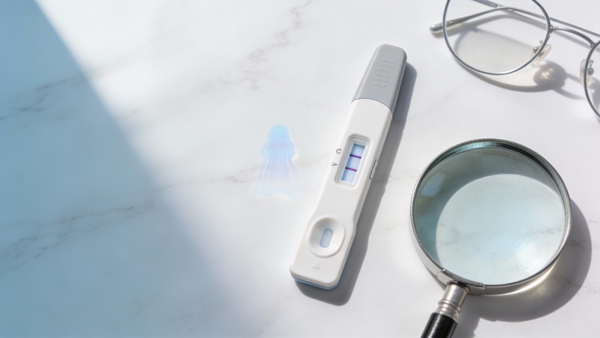
Why Pregnancy Test Lines Are So Hard to Read and How AI Technology Is Changing That

That Sinking Feeling of Uncertainty
You're staring at a pregnancy test, squinting under different lights, tilting it at various angles, maybe even asking your partner or friend to take a look. "Do you see a line there? Is that pink or gray? Am I imagining this?"
If this sounds familiar, you're not alone. Millions of people struggle with reading pregnancy tests every year, and there are legitimate scientific reasons why these seemingly simple devices can be so frustratingly unclear.
Why Pregnancy Tests Are Designed to Be Confusing
Here's the thing most people don't realize: pregnancy tests aren't actually designed with user experience in mind. They're designed for accuracy and cost-effectiveness in manufacturing.
The Science Behind the Lines
Pregnancy tests work by detecting human chorionic gonadotropin (hCG) in your urine. When hCG is present, it binds to antibodies on the test strip, creating a colored line through a chemical reaction. Sounds straightforward, right?
The problem is that this process isn't binary. It's not simply "line appears" or "line doesn't appear." Instead, it's a gradual process where:
- Line intensity varies based on hCG concentration
- Color development takes time and can change over several minutes
- Environmental factors like humidity and temperature affect results
- Manufacturing variations mean each test behaves slightly differently
The Gray Zone Problem
The most frustrating scenario is what experts call the "gray zone" – when hCG levels are present but low, creating faint, ambiguous lines. This happens because:
- Early pregnancy detection: hCG levels start very low and double every 48-72 hours
- Individual variation: People's hormone levels rise at different rates
- Test sensitivity differences: Some tests detect lower hCG levels than others
Common Reading Challenges That Trip Everyone Up
Evaporation Lines vs. Positive Lines
This is the big one. Evaporation lines appear when urine dries on the test strip, creating a colorless or gray line that can look suspiciously like a positive result. The key differences:
- Timing: Evaporation lines typically appear after the recommended reading window (usually 3-5 minutes)
- Color: True positive lines should have color (pink, blue, or red depending on the brand)
- Width: Evaporation lines are often thinner than positive lines
But here's the catch – these distinctions can be incredibly subtle, especially in certain lighting conditions.
Indent Lines and Manufacturing Artifacts
Some tests have slight indentations where the test line would appear, even when negative. These physical grooves can create shadows that look like faint lines, particularly under certain lighting angles.
The Lighting Problem
Fluorescent lights, LED bulbs, and natural sunlight all render colors differently. A line that looks clearly pink under bathroom lighting might appear gray under kitchen fluorescents. This isn't your eyes playing tricks – it's actual color temperature differences affecting how you perceive the test.
Why "Just Wait and Test Again" Isn't Always Practical
The standard advice is to wait a few days and retest, but this ignores the emotional reality of the situation. Whether you're hoping for a positive or negative result, that uncertainty period can be genuinely distressing.
Plus, there are practical considerations: - Medical timing: Some situations require knowing sooner rather than later - Financial cost: Quality pregnancy tests aren't cheap - Mental health: Prolonged uncertainty takes a real toll
How Technology Is Solving the Reading Problem
This is where things get interesting. Recent advances in smartphone camera technology and artificial intelligence are starting to address these long-standing issues.
Computer Vision Advantages
Unlike human eyes, computer vision systems can: - Analyze precise color values without being influenced by ambient lighting - Measure line intensity objectively using pixel density analysis - Compare against thousands of reference images to identify patterns - Account for different test brands and their specific characteristics
Machine Learning Pattern Recognition
AI systems trained on thousands of pregnancy test images can identify subtle patterns that human eyes might miss or misinterpret. They're particularly good at: - Distinguishing between evaporation lines and true positives - Accounting for manufacturing variations between brands - Providing confidence scores rather than just yes/no answers
Practical Steps for More Accurate Reading
Optimize Your Testing Conditions
- Use first morning urine when hCG concentration is highest
- Read results within the specified time window (usually 3-5 minutes)
- Use natural daylight when possible for color assessment
- Take a photo immediately after the recommended reading time for later analysis
The Documentation Approach
Instead of relying on real-time interpretation, try this: - Take clear photos at 3, 5, and 10 minutes - Use a white background for better contrast - Include good lighting from multiple angles - Compare photos side by side later
This removes the pressure of immediate interpretation and gives you reference points for comparison.
When to Trust Your Results
More reliable indicators: - Clear color development within the time window - Lines that appear progressively darker over 2-3 days of testing - Results consistent across multiple test brands
Less reliable indicators: - Lines that only appear after 10+ minutes - Colorless or gray lines - Results that seem to disappear and reappear
The Role of AI-Powered Analysis
Several apps now use artificial intelligence to analyze pregnancy test photos, and the technology has gotten surprisingly sophisticated. Tools like Nuva use advanced image recognition to examine test photos and provide objective analysis with confidence scores.
The advantage isn't that AI is infallible – it's that it's consistent. It won't be influenced by wishful thinking, anxiety, or poor lighting conditions. It can also explain exactly what it's detecting: control lines, test lines, and pattern analysis in clear terms.
These tools work with major brands like Clearblue and First Response, and they're particularly helpful for those ambiguous cases where you're genuinely unsure what you're seeing.
Managing Expectations and Next Steps
Whether you're using traditional visual reading or AI assistance, remember that home pregnancy tests are screening tools, not diagnostic tools. A healthcare provider can offer definitive answers through blood tests that measure exact hCG levels.
When to See a Healthcare Provider
- Consistently ambiguous results over several days
- Positive tests followed by negative tests
- Irregular bleeding with unclear test results
- Any concerns about your reproductive health
The Bottom Line
Pregnancy test confusion isn't a personal failing – it's a design limitation of the tests themselves. The good news is that technology is finally catching up to provide more objective, reliable analysis.
Whether you stick with traditional reading methods or try AI-powered analysis, the key is understanding why these tests can be so tricky to interpret. Armed with that knowledge, you can make more informed decisions about when to retest, when to seek additional confirmation, and when to trust your results.
Remember: you're not imagining the difficulty. These tests really are hard to read sometimes, and that's okay. The important thing is finding an approach that gives you confidence in your results and peace of mind during an already emotional time.
If you're interested in AI-powered pregnancy test analysis, you can check out Nuva on the App Store. The app keeps your data private and secure on your device while providing objective analysis of your test photos.